Showing posts with label electricity. Show all posts

Thursday, August 18, 2022

Is this news?


"The UN charter was never amended after the USSR broke up. It still references the Soviet Union, and not Russia, as one of the permanent members of the UN security council."   Ok o, but where is ECOWAS in this whole council?  Remove France give us our ting.  


ASUU still dey on strike, ok o.  No head or tail since nineteen ninetyyy something.  


Make sure you subscribe! 
Follow all my blogs on one twitter.  
Follow on facebook.
Order Big Girl and Big Boy.

Friday, August 10, 2018

Wednesday, November 23, 2016

Affordable Housing - How To Succeed

1. Stop complaining about the price of cement.  Start Digging.   
Wise civilizations have always built homes with what they have, not with what they have to obtain with difficulty.  Today's Nigeria is not a wise civilization I suppose, or we would use laterite bricks more. 
What is laterite?  The answer may be beneath your feet at the construction site.
https://www.google.com/search?q=laterite

2. Build more units than you need
Sell or rent to others, and make some money.  Be an answer to the housing crunch...Nigerians need answers.  Do you want to become an expert in affordable and sustainable building technology?  Start here. 
http://olojauk.com/article/with-n3m-15000-you-can-build-your-own-house-in-nigeria.html
http://thenationonlineng.net/building-a-functional-low-cost-house/
http://www.nairaland.com/1495068/build-red-bricks-hugely
http://www.nairaland.com/2209886/alternative-building-technique-affordable-housing
http://www.nairaland.com/1006963/affordable-low-cost-housing-option
http://www.vanguardngr.com/2012/04/affordable-housing-with-bricks-you-can-reduce-cost-by-40/
https://ng.boell.org/2015/03/03/affordable-green-housing-nigeria
https://www.google.com/search?q=natural+ventilation+demas+nwoko&client=firefox-b-ab&tbm=isch&tbo=u&source=univ&sa=X&ved=0ahUKEwj_hMz60r7QAhUpKcAKHShVAqoQsAQIGw&biw=1525&bih=745&dpr=0.9
Meet the experts, read their books and study their works, for example The Architecture of Renowned Master Demas Nwoko

3. Lower your running costs too
Fire NEPA/PHCN/xxDC , throw away the noisy generator (or give it to your enemy lol) and be your own solar power provider.  Also remember to build in time-tested natural ventilation and passive cooling systems from day 1, from the first drawing your architect makes.       
Thermal ventilation and Cross-ventilation

https://www.pinterest.com/pin/227713324885967853/

Get inspired: See more natural heating and cooling systems via snelhai's pinterest page
Ventilation Blocks
https://www.pinterest.com/pin/227713324883817608/
We can learn a lot about Passive Cooling from Cairo/Egypt, Yemen/Arabia, Iran/Iraq, and the Middle East in general.  Example: E.M. Okba (Cairo University) has notes on Building Design for Passive Cooling
Middle Eastern - style wind tower for ventilation
Traditional Badgir (wind-catcher) system
Apply wisdom.  Come back with a testimony. 

You may also like:  
http://upnaira.blogspot.com.ng/2015/12/still-trying-to-find-your-passion-what.html ,  
Using electric power at home ,  
http://lifelib.blogspot.com.ng/2011/01/agric-chic.html

Get UpNaira by email.
Order Big Girl and Big Boy.

Friday, August 12, 2016

Using electric power at home

My monthly use is less than 50 units (1-2 kWh per day). I am very proud of this.

Check your power bill or meter to see how many units you're using monthly. 

More affluent homes in Nigeria easily use 5-10 times as much energy per person from PHCN, 500 units per person! - and on top of that still have a generator with the life-wasting issues that come with that (waste money, time, and fuel to generate noise, stress, and fumes).
http://www.bonzaschooldays.com/investing/6-simple-tips-saving-energy-home/

Let us try to pity ourselves fa. :D

You too can cut down on your power use and even get off the grid with solar and storage.  See the future.  If you want to change, here are some tips for saving energy: 

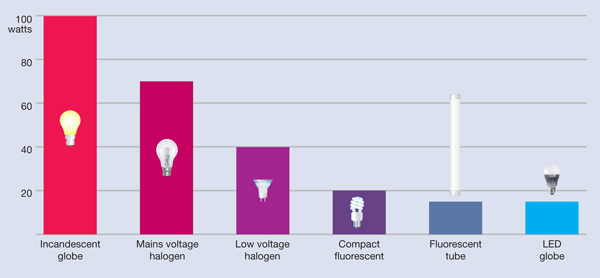
Use energy-efficient lighting.  You want light, not heat, right?  Change your "globe" to CFL - compact fluorescent light - or better.  Not only do you use 5 times less power and waste less as heat, but these CFL lightbulbs also last much longer before they need to be replaced.   
https://www.sa.gov.au/topics/water-energy-and-environment/energy/saving-energy-at-home/household-appliances-and-other-energy-users/lighting
Approximate power (Watts) used by different globes to deliver the same light output as a 100W incandescent old-school lightbulb
Use energy-efficient appliances in general.  Many times the engineers determine this anyway, so your more modern appliances are already more energy efficient than the old designs. 

Turn it off if you're not using it.   24-hour cable television in the empty rooms?  Outdoor "security" light on at midday?  Leave a 60 Watt bulb on 24/7 to indicate when "NEPA has brought light"?  At least change it to an LED light, please. 

Rethink ventilation and cooling.  If you use an A/C, is the room/space closed or are you attempting to cool the entire city?  :)  If you live in the tropics like most of Africa, is your space so uncomfortably cold that you're shivering indoors or have to use special clothing and bedding to survive?  Businesses do this a lot, actually - very annoying - and so people have to wear thick Western clothing in this tropical heat!  Can you have windows, vents, and well-designed air-flow substitute for the air-conditioner? 

Pay attention to heating appliances - they use A LOT more power.  You may not need an electric cooker because it is usually wasteful.  You should not keep your electric bathroom/kitchen water heater on infinitely when not in use.  If necessary, ask a professional about timers, thermostats and automation to make your home run more efficiently.  

Turn it down if a low level is good enough.  If your fridge-freezer only has water and bread in it most of the time, you don't need it at freezing point, so adjust the thermostat.  If you don't keep a lot of food, you can use the freezer compartment for all your fridge needs instead of over-cooling the whole space.  Change your airconditioner's set temperature to a comfortable level. 

Don't waste water.  Especially hot water.  It took a lot of energy to get that water.  Don't leave the shower running, don't leave the pipes/faucets leaking, and don't leave the pumping machine overfilling the tank.  Call in the professional to help you sort these things out.  Ideally, the government would provide water services, but even government water should be respected and conserved.  

If you take hot showers, ... just kidding!  Take your hot shower if you need it.  Hey, it's not about not being able to live well, it's about being conscious of the fact that these are Valuable and Non-Renewable resources, and acting responsibly in accordance with our conscience and pocketbook.  Keep that hot shower brisk. 

Don't forget to share this (buttons below) and add a comment.
 
Get email updates.
Order Big Girl and Big Boy.

Monday, December 14, 2015

Still trying to find your passion? What ANNOYS you?

I'm feeling a little under the weather today, but I had to go out twice to sort out an electricity billing matter.
http://pelfind.net/photo/86560p1841828/40-beautiful-handpicked-illustrations

I didn't like the early afternoon heat,
but how lovely it was when I stepped into the shade, say, of someone's streetside shop.
Why can't we keep the heat where we want it (in micropower plants, in boilers, and so on) and have shade where we want it (in our homes, offices, wherever we are)?
http://www.citylab.com/commute/2012/01/after-23-years-kazakhstans-subway-system-opens-its-doors/1061/

Is that not what science and engineering have been doing for years? Helping us control energy?
http://lifelib.blogspot.com.ng/2011/01/agric-chic.html
Science aside, how about hats?  With state-of-the-art HAT technology, I could stay nice and comfy in 30degree heat.
http://lifelib.blogspot.com.ng/2011/01/agric-chic.html
Ventilation at home too, of course.  But back to those micropower plants - how - maybe reflectors combined with solar cells?  And lots of trees to complete the shading effect?
/beautiful-city/

For the electric billing, what annoyed me so much was that this was my second visit, and then I had to wait, and then the customer service rep did me dis-service by asking me to get even more paperwork and come again.
http://pelfind.net/photo/48844p1155760/beautiful-examples-of-futuristic-city-skylines-illustrations

So I feigned a fit (they're never really real, are they) and said I would need to see her manager because their processes suck (she wouldn't like me to see her manager, I could see in her eyes), and it is HER job to make this easy;
and then I tried but the new paperwork probably doesn't exist, and it's all a scam anyway, and that got me thinking:
https://www.facebook.com/IKEJAElectric

1. ask google, because there'd be many sites telling me how to pay my power bill without dealing with all the human nonsense - and I have asked, and I have found these sites explaining "how to buy IKEDC units power" etc
2. ask someone to investigate where this money is going.  My actual power usage would cost a laughably small amount, say 600naira per month.
http://upnaira.blogspot.com.ng/2007/04/nepa.html
My 40 units since installation just ran out after 3 1/2 weeks, and I read online that the per unit rate is N12.50, and that it will be increased soon - Merry Christmas - and that there's a monthly service charge in addition to the usage charges of about N750 per month.
http://www.lifelib.blogspot.com.ng/2008_06_01_archive.html
For years I've paid about 3,000 naira per month, occasionally we've had to pay larger lump sums (we share a bill of which I pay 1/3 or so) , and supposedly I owe another 70,000 a third of over 200,000.  I'm required to pay 20,000 of that sum before being allowed to pay on the new meter.  And now I have to run around to pay this into separate mysterious accounts.
You see why we need investigators?
/beautiful-city/
You see why the new president tried to mandate a single account for the nation's treasury?  Because clever clever people create separate accounts, and would insult the customers doubly by making them runaround and file paperwork to feed them?  Meanwhile, I bet the electricity "company" itself is starving while Mrs. or Mr. Somebody has a racket running?
http://pelfind.net/photo/86560p1841828/40-beautiful-handpicked-illustrations
But what about the prepaid cards?  Can't I just buy a card, say 5k or 10k as advertised and be done with this payment nonsense for 6 months at least?  I'm not sure.  I've searched around the internet...maybe the systems aren't up and running yet.

I would beware of online payment portals, it's too easy to set up a fake one, and entering card data online on ANY NIGERIA PORTAL is at the very best an invitation to get defrauded at some point.  I'm still trying to get a response from the Central Bank from an old fraud case.  The bank won't refund, to which I say but if you're not liable then you have no incentive to protect my card/account which I didn't use in any special way anyhow, only used at ATMs and shops.  Now I no longer use the card at shops - I withdraw cash first and take that to the point of sale.  It's a shame.
http://upnaira.blogspot.com.ng/2012/01/too-big-to-jail.html
As you can see, there's a bit of anger here.  What am I going to do about it?
First, I'm going to do the human nonsense, this is Nigeria after all: I'll get some units on my prepaid electricity card by the buddy system, screw the backpayment.
http://pelfind.net/photo/75490p1664398/beautiful-illustrations-by-teagan-white

I'll hope there's an exposé at some point that tells poor residents not to pay the inflated amounts into the strange Zenith Bank accounts or wherever.  It's so not fair; these people can't buy any luxuries for Christmas and have to save it all to feed the power scam.  
http://pelfind.net/photo/75490p1664398/beautiful-illustrations-by-teagan-white
I'll wear a raffia hat sometimes even if it's not fashionable.  It's the logical thing to do, it IS.
I'll go to the beach and enjoy the country.
Do you know how perfect it is in the morning and evening when it's a mild 25ish degrees and just leafy paradise?
http://pelfind.net/photo/75490p1664398/beautiful-illustrations-by-teagan-white
I'll try to be an engineer and train engineers that re-think society, that create the type of energy management that I described here: comfort, power, sustainability, in a comprehensive design. 
http://pelfind.net/photo/86560p1841828/40-beautiful-handpicked-illustrations

I'm still trying to find my passion - to find the word to describe it.  But talking about things and getting people to locate their anger is part of it.  Blogging?  Policy (Social engineering?)  Engineering itself?  Even fashion? And urban design.  Definitely teaching.

But the passion, should it be one thing? 

Get UpNaira email updates

Wednesday, April 22, 2015

What Africa needs now: Transnational infrastructure, Transparency in systems, Using and developing all her people, ...

Akinwumi Adesina is running for President of AfDB. He was a Most-Valuable Player on the Nigerian Federal Cabinet, so I say yes, hope he gets the job. 
https://www.google.com/search?q=akinwunmi+adesina
Get UpNaira email updates

Speech by Dr. Akinwumi Adesina, Nigerian Minister of Agriculture and Rural Development and candidate for President of the African Development Bank 
Delivered at the Business Council for Africa’s Annual Debate
21 April 2015

Africa is experiencing a never-before-seen economic and political transformation. Five of the world’s ten fastest-growing economies are located here. It has rightfully created tremendous excitement not only within our borders, but around the world.

 While there are many reasons to celebrate the improved economic performance, daunting challenges remain and troubling trends have emerged.

We are facing widening economic and social inequalities that have resulted from non-inclusive growth. Africa’s poverty rates are still the highest in the world. Despite gains that have been made, the reality is that 44% of Africans still live on less than $1.25 per day.

These are struggles I know. I grew up in poverty, the son of a farmer who worked for less than 10 cents per day. I was one of the lucky few to attain education and opportunity. I don’t want my story to be the exception, I want the cycle of poverty to be broken across Africa. Our economic success needs to be shared – with prosperity for all – creating a more equal, stable, and peaceful continent. Nothing is more important than putting an end to poverty.

We are also facing rapid urbanization that will determine the resilience of the growth process.

We have exceedingly high levels of unemployment – which leads to social, political, and economic fragility.

Fragility is on the rise. 53% of Africa’s nations are fragile states. Fragility, joblessness, and economic and political exclusion breed terrorism. We need to tackle the fundamentals of fragility.

We are on the receiving end of climate change. Although Africa has done little to contribute to the damage, we are suffering heavily from the effects of it. We are paying a disproportionate price for climate change.

While we should celebrate our achievements, we also need to recognize that these key challenges must be tackled head-on by the African Development Bank. We need to renew our commitment to addressing these together – with both regional and non-regional members. As we do so, the Bank will grow into its role as the premier finance institution on the continent.

That is why I am running for president of the African Development Bank.

To make progress, the next President must not only understand the merits of a policy or strategy, but how to translate it into action on the ground. This is something I have done over the course of my career.

I’ve implemented innovative finance schemes in several African countries – from Uganda to Tanzania, Kenya to Mozambique, Ghana to Nigeria. I’ve helped to leverage over $4 billion from commercial banks to finance agricultural SMEs. And I launched an electronic wallet program which helped to end corruption in the fertilizer sector in Nigeria, and has reached 14.5 million farmers and impacted 50 million people. These are programs that have real impact on the ground.

Having lived and worked in 15 African countries, including 10 years in francophone countries, I have experienced firsthand the complexities of what our continent needs.

Too often our decisions are driven more by our own political interests or policy preferences, when it should be driven by the needs of those we are seeking to empower. This is particularly important when speaking about a continent so ecologically, socially, and economically diverse as Africa. There is no one solution or quick fix.

First and foremost, the question is: what kind of Africa do we want?

 I want an Africa with inclusive and sustainable growth, and one that is globally competitive. As President, I will focus on five strategic priorities: integrated infrastructure, private sector growth, increased employment opportunities, reviving the rural economy and regional integration.

The focus, across the board, will also be on scaling programs that have delivered results —tangible outcomes, not merely outputs.

Across all the priority areas, we need to strengthen integrity, transparency and accountability. We will demand of ourselves the same thing as we demand of our countries. We must manage our resources well, and we must always examine our actions from the perspective of the public. We must put people first, because ultimately we are investing in a better future for them.

Let me speak briefly to the priority areas.

We need to minimize the global widening of the infrastructure gap. There’s no lack of ideas about what Africa needs to do on infrastructure – the key is how you turn them into bankable projects. We need smart projects.

 In infrastructure, the players are many but they are not coordinated. The Bank can play that role effectively: funneling money to the right priority areas. The Bank should engage all domestic, regional and international partners – including established partners, like the World Bank, and newly emerging players, like BRICS’ new development bank. I will also lead the bank to focus on rapidly building infrastructure for small and fragile states.

We need to mobilize greater resources to finance infrastructure in Africa. To manage that effectively will require $93 billion per year and will require mobilizing domestic resources, private sector funds, and multilateral financing. Leveraging capital markets is crucial to improving our approach to infrastructure.

We need to prioritize the kind of infrastructure projects that will help us deliver “power-for-all” – universal access to electricity. Access to power is absolutely vital to Africa’s development. Africa has 50% of the world’s renewable energy, but it remains largely untapped. Developing energy infrastructure will drive rapid economic and social development. We should target investment toward renewable energy – solar, hydropower, geothermal, wind. And we should have a two track approach - supporting a combination of large, transformative regional power projects and smaller projects that can be implemented more quickly to create immediate impact in local communities.

Africa’s private sector accounts for 70 percent of investment, 70 percent of output and 90 percent of employment. The private sector can drive industrialization in Africa and unlock wealth at all levels of society. The Bank needs to develop its private sector operations.

Back in 2005, the Bank was lending $250 million. By 2013, it was lending $2.1 billion. Clearly, a lot is being done in private sector, but it is still not meeting the needs. For inclusive growth, we have to direct financing to empower entrepreneurship for those that impact the majority of the population – SMEs in the private sector. As President, I will work to build the financial intermediaries needed to deliver affordable financing to African companies. We will establish business development advisory services targeted at positioning SMEs to secure venture capital and private equity funds.

The equity capital market accounts for $1.5 trillion per year, but these funds are heavily concentrated in just three countries: South Africa, Nigeria, and Namibia.  We need to deepen the market to mobilize financing – we need to get these funds to smaller and fragile countries. It can’t all go to the same three places, that’s not real progress.

We also need to mobilize domestic resources. Non-regional donors must have a leveraging effect. There are a lot of domestic resources in Africa: such as pension funds, sovereign wealth funds, and diaspora funds – and we have to unlock them. We have $158 billion in sovereign wealth funds alone. We need to put it to good use.

And we need to prioritize blended finance - combining public and private financing - to reduce risk exposure to the private sector.

We need to work with governments to lower the cost of doing business across Africa. Currently 18 out of the 25 least competitive countries are in Africa. This needs to change. Enabling the private sector will increase the opportunities in the job market. Changes need to be made to address the fact that the economic growth we have today is jobless growth. And we need to pay special attention to unemployment among two populations: youth and women.

30 million youths enter the market annually, and we need to create jobs for them. This is not just an economic priority. It is a security investment. Without jobs, we face economic, social, and political risks. As many of you know, the majority of youth who turn to violence have no job—and seemingly no options. 50% of young fighters in Sierra Leone and Liberia participated in the violence because they didn’t have jobs.

And we’re facing a migration crisis – largely due to an absence of jobs for our young people. I want to build an Africa that keeps and attracts talented, hardworking people. Our people should not be boarding ships, putting themselves at incredible risk, in search of hope and a chance to make something of their lives. That’s why I believe we must build a more prosperous continent that will give hope and opportunities to tens of millions of our youth. We want an Africa where they want to stay, not an Africa they want to move away from.

You can’t develop without women. Investing in women is not just the right thing to do, but also the smart thing to do. Women are the primary source for growth in local economies. Yet today, 64 million more women than men are unemployed in Africa. And if we don’t address women’s unemployment, we’re not going to make a dent in the broader unemployment crisis. Women need access to education, technology, jobs, and financing.

As president, I will lead the African Development Bank to implement an Annual Gender Score Card and an African Women Empowerment Index, because we shouldn’t just talk about women empowerment – we should actually do it and measure that we’re doing it well.

And with 50% of Africa’s farmers being women, we must commit to reviving the rural economies for their benefit as much as anyone else’s.

We need to change the way we see agriculture – it’s not merely about development, it’s an economic driver. If you use agriculture as an engine to revive rural economies you create new prosperity zones for the people and that will have an impact on reducing insecurity problems.

Africa has 65% of all the arable land left to feed the 9 billion people in the world by 2050. Transforming the agriculture sector will have the largest impact on inclusive growth on the continent, given that 70-80% of the labor force is engaged in the sector but are locked into poverty.

We must provide innovative financing instruments and direct private equity funds toward agribusiness investment. By reviving rural economies and empowering them with tools to connect their goods to viable markets, we will unlock incredible opportunities for growth, ensure equitable growth and realize the promise of a shared prosperity—as we lift millions out of poverty.

We need to diversify the economies in African countries that are rich in natural resources, to shield them from over-exposure to volatilities in global markets (as we saw recently with falling oil prices). Focusing on unlocking agriculture’s potential will go a long way toward diversification and building "soil wealth" rather than relying on oil and mineral wealth.

Much of Africa’s growth is due to commodities and high extractive rates. Focusing on exporting our abundance of raw commodities makes African economies vulnerable to volatilities in commodities prices. Unless this is changed, Africa is like a giant with feet of clay. We need to lead these countries toward diversification. And agriculture is key.

We also need to improve management of those natural resources – transparency and accountability must be enforced. Africa is not poor, but its people are poor because money disappears. That needs to change. Africa is rich in natural resources, with $85 trillion in discovered resources, but it loses $60 billion per year in illicit outflows. We need to work on all levels to enforce transparency and accountability. This money should be going to development – to advancing healthcare and education in our communities. Imagine what that $60 billion could do for our people each year. Africa’s resources should not belong to the few, but should be for the benefit of all.

We need to reduce inequalities in economic prosperity among countries in the region. We should integrate our region. Economies that focus on regional markets are less vulnerable to price fluctuations.
 The world’s most prosperous trading blocs are heavy on interregional trade.

Landlocked countries need to be connected to coastal ports through investment in transnational infrastructure, especially highways, trans-boundary water basins, and railway, maritime, and air transport systems. We must deliver integrated infrastructure and eliminate barriers – this will expand the size of the regional markets and reduce the cost of movement of goods, services and people, creating a more open Africa.

I know the roadmap toward that vision for Africa is challenging, but we are already seeing tremendous progress, and we now have the confidence to achieve even greater results.

We need to build a Bank with a pulse for Africa’s people. A Bank that is more impact-oriented, efficient and responsive to the needs of its clients in a rapidly changing, multilateral economic landscape. A Bank that will be the partner of choice for all things African development.

We must build an Africa that will unlock greater opportunities with hope and prosperity for all. An Africa that all Africans can be happy to call their home. Together, we can achieve this.

THE END.
Source : adesinaforafdb.com 
Get UpNaira email updates

Wednesday, May 29, 2013

The Nigeria Premium on electric power generation cost

Worldwide, and for at least thirty years, the installation* cost of large-scale power plants has remained steady** at about $1 billion per 1,000 MW. 
Interestingly, in Nigeria, when projects or projections are announced, they drift far from this estimate, and I wonder why. 
An electric power system
* I mean the cost of building the plant, given in dollars per GW.  Different from the cost of running/operating the plant, which is given per MWh.  
**I'll try and find a reference.  I originally deduced the $1 billion / gigawatt estimate from a ?2009 Nigerian government planning document that showed a graph of of capacity vs. cost for dozens of large (roughly 0.1-10GW) power projects in various countries over the decades, and it struck me how power provision is a commodity, a thing that could be accomplished with cash and without any high-tech competence whatsoever. It also showed clearly that there is a stable price for this commodity.    
Aside, this is beautiful - all the large power plants in the world in one map: 


Wednesday, December 19, 2012

Case studies in electric power utility management

This series from Der Spiegel International is utterly fascinating. 

German Energy Agency Chief: 'We'll Need Conventional Power Plants until 2050'

SPIEGEL ONLINE - November 15, 2012 German Energy Agency Chief: 'We'll Need Conventional Power Plants until 2050'Stephan Kohler, the head of the German Energy Agency, says the country must act smarter and more realistically in its transition to renewable energy. The "feel-good" subsidies for locally produced wind and solar power have had unintended consequences, he says, and the environmental movement is often part of the problem. more... [ Forum ]

Quagmire in the Sahara: Desertec's Promise of Solar Power for Europe Fades

SPIEGEL ONLINE - November 13, 2012 Quagmire in the Sahara: Desertec's Promise of Solar Power for Europe FadesAs recently as three years ago, many thought that it was only a matter of time before solar thermal plants in North Africa supplied a significant portion of Europe's energy needs. But Desertec has hit a road block. Industrial backers are jumping ship, political will is tepid and a key pilot project has suddenly stalled. By Joel Stonington more... [ Forum ]

The High Price of Clean Energy: Tax Breaks and Subsidies for Industry Divide Germans

SPIEGEL ONLINE - October 26, 2012 The High Price of Clean Energy: Tax Breaks and Subsidies for Industry Divide GermansMajor industry is being spared of the costs relating to Germany's expensive shift from nuclear to green energies. The burden is being placed on small and medium-sized business as well as German consumers, who pay the second highest price for electricity in Europe. Resentment is starting to grow. By Jörg Schindler and Gerald Traufetter more...

Rising Energy Prices: Germans Grow Wary of Switch to Renewables

SPIEGEL ONLINE - October 15, 2012 Rising Energy Prices: Germans Grow Wary of Switch to RenewablesGermany's switch to renewable energies is driving up electricity bills across the country, with a green technology surcharge set to rise by nearly 50 percent next year. With frustration over the high price tag, it promises to become a key issue in next year's election campaign. more...


Merkel's Blackout: German Energy Plan Plagued by Lack of Progress

SPIEGEL ONLINE - October 10, 2012 Germany plans to abandon nuclear power by 2022, but its government hasn't been doing enough to ensure that the project succeeds. Needed infrastructure and technology is lacking, and coordination is a mess. Meanwhile, weary consumers are paying more for electricity, and the supply is in jeopardy. By SPIEGEL Staff more... [ Forum ]

Flexible Fossils: A New Role for Coal in German Energy Revolution

SPIEGEL ONLINE - September 07, 2012 Flexible Fossils: A New Role for Coal in German Energy RevolutionOne of the biggest challenges of Germany's ambitious energy revolution is the fact that renewables such as wind and solar are subject to large fluctuations in output. Coal has long been considered their dirty alternative, but a new generation of power plants may herald a glowing future for the fossil fuel. By Stefan Schultz more... [ Forum ]

Find more here: Spiegel.de/.../Energy

Friday, December 07, 2012

Can reduced government spending enhance our economy?

A few approaches to answering this good question:

Anti-corruption - At this time, we need to reduce the financial reward for political officeholders to discourage "do-or-die" politics and perhaps encourage eggheads like me ;)

Economic growth - Produce more (consume less?) is the current imperative.  To produce more, we need to get infrastructure up, and rent-seeking down.  We must get more small-chunks of resources to productive hands, and disperse the glut of resources at the center (mostly from oil receipts).  This is understood but implementation is slooow.

Electricity - If we would get electric power provision right, we would spend less next year on diesel, generators, transport, communications, health and so on.  Ok, this has little to do with reduced government spending, but it's so important for our economic growth that I had to sneak it in.

Inflated budgets - Study the details of the budgets proposed for various agencies, ministries, etc.  Clearly most are overbudgeting: multiple requests for the same items, wage bills that can't possibly be explained by multiplying the small take-home pay by the number of staff, ... and other inconsistencies.  Why?  And what is the way forward?  Can we encourage these units to review their budgets, come up with new numbers, and maybe reward the rank-and-file staff with extra pay from the savings?  We could create a dropbox for such reviews.

Nine zeros is a billion. I can hear you say "What the hell is the National Judicial Council"

Proven unproductive sectors - a lot of the civil service and political class is unproductive, in the sense that their work has little positive effect on society.  Here are some of the ways this is so:

- Some of the staff doesn't exist i.e. ghost workers

- Some of the staff shouldn't exist e.g. We pay a stupendous pension to the families, multiple widows, and children of former military rulers and other presidents, and governors.  Why? Should they not also work?

- Some of the staff is actually anti-productive e.g. creating redtape and harassing citizens so as to collect bribes.  We ought to put such people in jail.  Instead we keep paying them to further destroy the lives of Nigerians.  For example, multinational wants to set up shop in Nigeria, you refuse unless you (not your people) can get a cut.  God will punish you.  You throw away qualified resumes sent to your boss so that you can sell the open position or give it to your cousin. 

- Where work is done, some of it is unproductive e.g. a workday that consists mostly of the effort to groom oneself, take stressful transportation methods, then settle in to gossip and or power-seeking at the office before heading back home.  It does not add anything to the world, except pollution maybe.  A legislator that can't or won't consider policy that would move the country forward but would travel all over for training (read sightseeing), seat-warming at high-tables, oversight functions like inspection of construction projects.

- A lot of the staff is good-for-nothing on the job, since the process of getting the job doesn't emphasize competence e.g. Last-minute money-sharing will get you to the National Assembly.  Being somebody's cousin will make you their paid assistant.  

- Some of the staff is redundant.  Because they do not have the necessary skills, additional skilled staff has been hired to get the job done.  There must be a stylish and humane and supportive way of either retraining them or relieving them of their duties maybe with a severance package and a business loan or school loan.

Sharing the pain -  Before the protests against subsidy removal this January, the president announced a move to cut salaries in government.  If we have given up our fuel subsidies and are making do with less, where is the matching contribution from the ruling class? How is it that they carry on wasting, carry on being overpaid, carry on receiving multiple "official" vehicles, while we are sacrificing for the future? 

Summary: Some belt-tightening may have occurred in the Nigerian government, but with a 70-30 allocation between recurrent and investment spending, the situation is far from satisfactory.  Government spending needs to be further reduced in favour of more productive spending. 

Read more:
- Budget Proposals at the Budget Office, Federal Ministry of Finance, Nigeria
- Nigeria needs to reduce rent-seeking (search result includes Udah and Obguagwu 2011, Coolidge and Ackerman World bank)
- Jonathan cuts salaries of government officials by 25% (reported January 7 2012).  He said in his speech: For the year 2012, the basic salaries of all political office holders in the Executive arm of government will be reduced by 25%. Government is also currently reviewing the number of committees, commissions and parastatals with overlapping responsibilities. The Report on this will be submitted shortly and the recommendations will be promptly implemented. In the meantime, all Ministries, Departments and Agencies must reduce their overhead expenses.

Monday, November 05, 2012

Battle time in transformation land

Nigeria has come a long way from April when I was frustrated about Delays in Power, the Petroleum industry bill, even the systems of business grants and buses that were promised as a palliative measure after the partial roll-back of subsidies on fuel importation.  We've seen the buses, we're glad about YouWIN, but there are still some problem spots:

Power - As at September, and even until now, the use of available power infrastructure was improved such that many homes + businesses started getting the highest level of "nepa-on" that they've seen in years.  This is a  fantastic development that gives us hope that we can complete the journey in electric power provision.  Note that the improvement so far - from over 2,000 to around 4,000 MW on a max capacity of 5 or 6 thousand - is little compared to what we are really hunting for (in the tens of thousands).
Power Privatization progress is that
1. the generation companies finally got new owners / operators (except for Afam, connected to the resignation of the former Minister of Power, Barth Nnaji)
2. The preferred bidders for the distribution companies have been announced (some bidders complained about the process, but it seems they don't really have a case)
3. the transmission company got new management three months ago, but on paper only.  Business Day reports reveal vested anti-privatization interests in the upper ranks of the privatization process, if that makes any sense.
This is probably why the Minister of State for Power (not to be confused with Minister of Power, still a vacant seat) was moved to the Niger Delta portfolio, and a woman, Zainab Kuchi, erstwhile Minister of State for Niger Delta Affairs, brought to replace him.
Current Battlepoint: Install Manitoba as an independent manager of the Transmission Company of Nigeria, that is free to apply its considerable technical base in the growth and management of Nigeria's electric power industry.
If this fails, it may be "cheaper" for the country to allow/license private concerns to develop new transmission infrastructure (natural monopoly or not; there are situations in which such redundancy is normal) and perhaps to weaken the need for the transmission company by allowing local/regional power projects. 

----------------------------
Security - Our people are still being killed in the name of Boko Haram.  A recent study highlighted that the strong-arm response of the military is making the problem worse.  Well, we learn everyday.  I know that Nigeria will use this feedback to work on ensuring our security. 
Current Battlepoints: Ok this one is not a battle, it may need a long-term strategy.

----------------------------
Petroleum - After the subsidy protests, there were four panels set up, including one charged with speeding up the passage of the PIB.  Poor bill, it is being debated still.
Now it turns out that the other three panels had their reports hidden/junked for months, then one was leaked, and now finally the reports will be seen by the President.  It will be fantastic if the reforms they suggest can be taken seriously.
I know that there are political reasons why some may not want these common-sense reforms. For example, in the absence of an alternative system for funding political parties and campaigns, a transparent petroleum revenues account means you're killing the funding for one party.  Many are focused on the idea that the reforms would dilute the power of the individual who holds the Minister of Power portfolio.  But clearly you can't be Minister of Power forever, so there must be a higher reason, right?    
At any rate, I would advocate that we favour light over darkness.  Let's not cover up the cover-ups.  Let us instead work through the issues and find ways to truly make Nigeria progress and prosper.
Current Battlepoints: Finalize the petroleum industry laws so that the players know what's up. 


----------------------------
Power, again: What the hell is happening in Lekki?  On the one hand, they probably demand a lot of power per person.  On the other hand, why are they not getting improved power supply in Lekki of all places?  My guess is that high corruption is taking place to ensure that Lekki residents continue to spend on generators and fuel.  Somebody needs to be fired, but who?
What we want

Wednesday, September 26, 2012

Privatizing electric power generating companies

The preferred bidders for the five state power plants are : 
Transnational Corp. for the 947- megawatt Ughelli power station.
China Machinery Engineering Corp. (leading a group of companies) for the Sapele plant.
Amperion Power Distribution Ltd. for the Geregu plant.
Mainstream Energy Solutions Ltd. the Kainji hydro plant.
North-South Power Co. Ltd. for the Shiroro hydro power plant.
Kainji Dam

Nigeria, Africa’s top oil producer, is selling majority stakes in power plants.
The country will also let private investors buy as much as 70 percent of 11 distribution companies spun out of the former state-owned utility NEPA/PHCN.

Read More at Bloomberg - Nigeria names winning bidders for five state power plants.
More photographs of Kainji hydroelectric power site at skyscrapercity.

Wednesday, February 23, 2011

Lagos Survival Guide

2011 Liveabililty Ranking and Overview has rated Lagos as the world's fourth worst city of 140 cities surveyed. Some of us have to live in Lagos. Here's how to stay zen through it all:
1. Live near work
Eschew the commute. You don't want to be like the mumu who saved money on housing only to lose it all on fuel and auto-mechanics. Or the other mugu who falls asleep at work everyday after spending four hours a day in traffic.
2. Serviced flat
You could be your own maigadi, generator operator, water pumper, and maintenance staff rolled in one. Or you could have your estate manager do it for you. This could mean staying in a hostel that has services covered for cheap. It doesn't have to be one of those million-million Ikoyi houses.
3. Other?

Tuesday, January 11, 2011

Correcting the power roadmap

The people of Nigeria have prioritized three action areas for our leadership to pursue. The first of these is ELECTRICITY. The current administration aims to attract foreign investment to the power sector.
The plan is laudable, but the reform should be led by an expert at deregulation, who is wholly committed to fairness. The former leader at the Nigerian Communications Communications (NCC, which successfully deregulated the telecommunication sector) would seem an ideal choice.
Besides inexperienced leadership, another obvious problem is the insistence on a transmission monopoly. To retain a monopoly in transmission would be wrongheaded; please liberalize everything.

Why say NO to transmission monopoly?
The current power roadmap will have us privatize generation and distribution and manage transmission in-house. If I was an investor, I'd rather build my own transmission infrastructure (duplicate) than throw my money away by trusting that transmission will be there for me. If we start with competing transmission links, in the long run, the network will be rationalized through trading. If we start with one transmission link, it is extremely likely to be the bottleneck in the whole national power system.

Arguing for monopoly:
1. Indian technocrat: Transmission is a natural monopoly, but he also identifies demand-supply gap considerations. China which presumably had competing transmission providers, had to restructure down to two companies.
2. BPE boss in Nigeria: Will be uneconomic to ask every operator to build its own network but NESCO has worked well in spite of having built its own network.

Arguing against monopoly:
1. Academic report: Questions the natural monopoly of transmission as well as the requirements of existence, profitability, and efficiency of a transmission market. So much grammar, but it squares with my intuition.

2. Nigerian administrator: With such an atomized approach and the insistence on a public sector transmission monopoly company whom are we trying to attract? We know how dismally public sector parastatals have performed over the past four decades. Exactly. In particular, NEPA/PHCN has received the "investment" to generate (assuming 1bn USD per 1000MW) tens of thousands of megawatts in 2000-2010, but what happened? Were existing plants maintained, even? Or what is the state of our transformers and transmission lines?

Friday, December 31, 2010

Le progrès, c'est chic

What is currently wrong with Nigeria and my thoughts on possible effective solution(s) to address the problem. December 31, 2010 update. By Tosin Otitoju.

The people of Nigeria have prioritized three action areas for our leadership to pursue:
1. Electric Power
The current administration aims to attract foreign investment to the power sector. The plan is laudable, but the reform should be led by an expert at deregulation, who is wholly committed to fairness (hint: Ndukwe over Nnaji). Also, the insistence on a transmission monopoly is wrongheaded; please liberalize everything.
2. Better Government
At the national level, Nigeria needs a technocracy – leadership by those with know-how. At the local and state level too, the quality of candidates must rise. Good people (such as yourself) must offer themselves for service.
To destroy the corrupt culture, known looters must be punished. We must commit to anti-fraud practices, such as service automation, forensic accounting, and public oversight.
3. Job creation
To create jobs, we need more risk-takers over job-seekers. They must be provided with capital, often micro-capital. We need access to overseas markets, and better transport and communication networks for local trade. Our education must give effective preparation.

My 2008 essay highlighted some problem areas. Since that time, many programs sprouted to train youth for leadership and entrepreneurship, and Lagos State Government massively improved that city. On the other hand, corruption remains an issue, and religion remains a source of deadly conflict. The arts flower tentatively, with recent successes in film, music, festival, and literary production. Civil society is awakening; citizens stage the occasional protest, only to find that their voices DO count.

As black people, we will continue to define success on our terms: rooted in universal principles, founded on a sense of our history, and in harmony with other cultures. Our quest for a better society will find us copying success stories, for example, an African Union patterned after the European Union; Institutes like the IITs that produced the high-tech workforce of India; press freedom and open government as in Scandinavia; and sovereign wealth management as in the Arabian Gulf. At other times we will walk our own path, for example: doctors favoring homeopathy, legislators working part-time, engineers for reforestation, agricultural chic, and Imams for Jesus.

Wednesday, December 01, 2010

Falling prices for phone calls and internet

Very exciting how competition improved service and pricing in telecommunication in Nigeria.
Who's switching to Airtel?
BusinessDay reports that "In the coming weeks, Nigeria’s highly competitive telecommunications market will witness sweeping squeeze in call-rate prices following Airtel Nigeria’s move to crash prices of mobile phone talk-time to as low as N9 per minute from the current industry rate averaging N35 to N42 per minute across networks...

Analysts view Airtel’s move as strategic for market share as it intends to invite new subscribers on to its network and wrestle existing ones from competing networks. This, of course, will boost revenue in the long run as Airtel will enjoy better economies of scale through reduced cost per unit of delivering services as volume increases.
..

[meanwhile] The internet download price slash has forced prices down to as low as N3,000 from N10,000 in less than three months with MTN leading the slash race. Industry experts believe the price will in no time drop to levels comparable to UK charges which is currently about N1,250 or 5 UK pounds sterling
"

On the other hand,
I wonder how much competition is planned in Nigeria Electric Power: not as much as one would like. Instead we have excuses about how inefficient it would be to duplicate distribution and transmission systems. This means that while there might be multiple players in power generation, we would try again and see if a government transmission company would replenish its infrastructure and give reasonable performance. No way. If we want decent electric power, we must duplicate first, harmonize later. It may seem wrong, but it's going to be right.

Wednesday, July 21, 2010

Electricity on Demand

The NERC and the NCC. One works, the other...not quite.

The Nigerian Electricity Regulatory Commission (NERC) is an independent regulatory agency which was inuagurated on 31st October 2005 as provided in the Electric Power Sector Reform Act 2005.
The Commission is mandated to carry out:
  • The monitoring and regulation of the electricity industry
  • Issuance of licences to market participants, and
  • Ensure compliance with market rules and operating guidelines.

The Nigerian Communications Commission is the independent National Regulatory Authority for the telecommunications industry in Nigeria.
The Commission is responsible for creating an enabling environment for competition among operators in the industry as well as ensuring the provision of qualitative and efficient telecommunications services throughout the country.

Thursday, November 26, 2009

LIGHTUPNIGERIA FLASH MOB

What is a flash mob?
Remember them from five years ago?
This is just the flavour of madcap hilarity we need to energize #lightupnigeria. One person picks a date, a time, and a funny central place, emails/texts race across the town within hours, and a crowd of thousands (or maybe just fifty) materializes somewhere: in VI, at a park in Ikeja or Maitama, or in Houston or London. A lightupnigeria flash mob. Hey, why don't you do it, be the first, don't forget to text me oh (my number is on my fb page)

http://www.wordspy.com/words/flashmob.asp
flash mob
(FLASH mawb) n. A large group of people who gather in a usually predetermined location, perform some brief action, and then quickly disperse. —v., —adj.
—flash mobber n.
—flash mobbing pp.

Example Citation:
The Internet has spawned a gaggle of new verbs — Googling, surfing and flaming are words most of us are used to hearing in everyday conversation. Now you can add "flash mobbing" to that list.

In recent weeks, New Yorkers have been using forwarded e-mails to coordinate "flash mobs," or not-so-random crowds that appear and dissipate within a matter of minutes. Is it performance art? The cutting edge of a new social movement? Or just an easy way to flummox carpet salesmen?

To protect the planned serendipity of each event, participants aren't told exactly what the mob is supposed to do until just before the event happens. For the most recent New York happening on July 2, participants passed around an e-mail telling them to assemble at the food court in Grand Central Station, where organizers (identifiable by the copies of the New York Review of Books they were holding) then gave mobbers printed instructions regarding what to do next.

The result: Shortly after 7 p.m., about 200 people suddenly assembled on the mezzanine level of the Grand Hyatt Hotel next to Grand Central Station, applauded loudly for 15 seconds, then left.
—Maureen Ryan, "All in a flash: Meet, mob and move on," Chicago Tribune, July 11, 2003

Earliest Citation:
As proof that some people have way too much time on their hands, consider the "flash mob" phenomenon.

Organizing a "flash mob" basically involves e-mailing a bunch of people with instructions to show up at a certain place for a few moments, then disappear.

According to www.cheesebikini.com, salespeople in New York were a bit confused when there was a huge, instant gathering around a particular rug. The flash mobbers agreed to tell the salespeople they all lived together in a warehouse in Queens and were thinking of buying a rug. The crowd dissipated after precisely 10 minutes. Poof.
—Kim Lamb Gregory, "Briefs," Ventura County Star, July 1, 2003

First Use:
Our senior Manhattan correspondent David Danzig reports that New Yorkers are using e-mail to coordinate "inexplicable mobs" — huge crowds that materialize in public places and suddenly dissipate 10 minutes later.
—Sean Savage, "Flash Mobs Take Manhattan," cheesebikini.com, June 16, 2003

Saturday, June 14, 2008

50,000 Megawatts

Expect state of emergency declaration in power sector by July, President Yar’Adua assures
Source

President Umaru Musa Yar’Adua announced on Friday June 13 in Paris that his Administration will formally declare a state of emergency in Nigeria’s power sector next month.

Responding to concerns expressed by prospective French investors over current power supply problems in Nigeria, President Yar’Adua said that under the emergency which will be in force for three years, the Federal and state governments will set aside Five Billion Dollars for the rehabilitation and expansion of Nigeria’s power generation, transmission and distribution infrastructure.

The President told the gathering of French businessmen that after the three-year emergency period, Nigeria’s generation and distribution infrastructure will be privatised while its transmission infrastructure will remain under the control of a state-owned company.

He said that Nigeria will seek additional financing from international finance institutions for the rehabilitation and expansion of its power infrastructure, adding that his Administration intended to establish a proper foundation for the increment of Nigeria’s power generation capacity to about 50,000 megawatts by the year 2020. More...

Comments!

Friday, April 27, 2007

Nigeria's near future

Yar'adua campaign video. He is to succeed as the next President of Nigeria.
Part One: Power supply is #1 priority.           Part Two: Focus on eradicating poverty.
     
Good politics articulates the desires of a people. We've seen clear articulation in the video!
Better politics focuses resources (people/institutions, money/materials, technology) effectively to meet set goals. Is this a good time for optimism?

Previously on UpNaira


Followers