Low-stress, Productive, Repetitive, Fun, Flexible - we don't all want/need the same things in a job.
Here is a wonderful resource page on JOBS FOR LAZY PEOPLE
Here is a previous post on 'ODD' Jobs that may just be right for you
You may also like: Unbundling Women's Work
Get Upnaira email updates.
Order Big Girl and Big Boy.
Showing posts with label holism. Show all posts
Showing posts with label holism. Show all posts
Tuesday, July 02, 2019
Tuesday, May 21, 2019
What could be better than #winning ?


Good question.
Get email updates.
Order Big Girl and Big Boy.
Studies show that increased salaries are not making people happier https://t.co/irUL4PbLGY— xoNecole (@xonecole) January 11, 2019
Get email updates.
Order Big Girl and Big Boy.
Sunday, May 19, 2019
Crime or Grime ??
1.
2.
3.

Naira Marley featuring Zlatan Ibile: Am I A Yahoo Boy
Get email updates.
Order Big Girl and Big Boy.
2.
 |
| by Adaobi Tricia Nwaubani, for the BBC |
3.
Naira Marley featuring Zlatan Ibile: Am I A Yahoo Boy
There is God o.
There is God o.
Get email updates.
Order Big Girl and Big Boy.
Monday, March 18, 2019
The importance of excess
Capitalism is a huge pain-in-the-ass, but:
(WATCH) The School Of Life: It’s only very recently in history that we’ve been able to buy more than the bare necessities. Can the history of consumption guide us to a wiser future?
Capitalism is a huge pain in the ass, and so are you.
Let's all have the most gorgeous + perfect week we've ever had.
Order Big Girl and Big Boy.
(WATCH) The School Of Life: It’s only very recently in history that we’ve been able to buy more than the bare necessities. Can the history of consumption guide us to a wiser future?
Capitalism is a huge pain in the ass, and so are you.
Let's all have the most gorgeous + perfect week we've ever had.
🌴
🌴
🌴
Get UpNaira email updates.Order Big Girl and Big Boy.
Wednesday, January 24, 2018
Hang out with SRK
Watch and share: An Insight, An Idea with Bollywood megastar Shah Rukh Khan. You know I will never waste your time.
Get UpNaira email updates.
Order Big Girl and Big Boy.
Tuesday, October 17, 2017
~*~ Business mentor + success coach
Free tips at instagram.com/alituplife :
We are not what you think we are // We are golden, we are golden. - Mika
Get UpNaira email updates.
Order Big Girl and Big Boy.
We are not what you think we are // We are golden, we are golden. - Mika
Get UpNaira email updates.
Order Big Girl and Big Boy.
Sunday, September 03, 2017
Thursday, July 20, 2017
What is a real job anyway? Here are some examples:
The Wildlife Keeper


and one more:
More interesting options here: So You Want My Job / Trade on www.ArtOfManliness.com
Get email updates.
Order Big Girl and Big Boy.
The Stay-at-Home Parent
The Professional Gambler
and one more:
More interesting options here: So You Want My Job / Trade on www.ArtOfManliness.com
Get email updates.
Order Big Girl and Big Boy.
Friday, May 26, 2017
Share this too
Mark Zuckerberg Delivers Powerful Speech at Harvard… https://t.co/3m22uWFE43 pic.twitter.com/uPDZSfSjZ5— BellaNaija.com (@bellanaija) May 26, 2017
Get email updates.
Order Big Girl and Big Boy.
Monday, November 30, 2015
Wikipedia : Simple Living
Simple living encompasses a number of different voluntary practices to simplify one's lifestyle.

Get UpNaira updates by email
- These may include reducing one's possessions, generally referred to as Minimalism, or increasing self-sufficiency, for example.
- Simple living may be characterized by individuals being satisfied with what they have rather than want.[1][2]
- Although asceticism generally promotes living simply and refraining from luxury and indulgence, not all proponents of simple living are ascetics.[3]
- Simple living is distinct from those living in forced poverty, as it is a voluntary lifestyle choice.

Mahatma Gandhi spinning yarn in 1942. Gandhi believed in a life of simplicity and self-sufficiency.
- Adherents may choose simple living for a variety of personal reasons, such as spirituality, health, increase in quality time for family and friends, work–life balance, personal taste, frugality, or reducing stress.
- Simple living can also be a reaction to materialism and conspicuous consumption.
- Some cite socio-political goals aligned with the anti-consumerist or anti-war movements, including conservation, degrowth, social justice, ethnic diversity and tax resistance.[4]
Get UpNaira updates by email
Wednesday, May 13, 2015
Zen and 'The Game' - is this what it means to grow up?
You've got to keep in the game / retaining mystique while facing forward / I suggest a reading of 'A Lesson in Tightropes' or 'Surfing your high hopes' or 'Adios Kansas' / it isn't very smart / tends to make one part / so brokenhearted... (musician/songwriter Rufus Wainwright, in track 1 on album 2: Poses, 2001)
I'm out of the game / I've been out for a long time / Now I'm looking for something / That can't be found on the main drag. (Rufus Wainwright again, in track 1 on album 7: Out of the Game, 2012)
Get UpNaira email updates


I'm out of the game / I've been out for a long time / Now I'm looking for something / That can't be found on the main drag. (Rufus Wainwright again, in track 1 on album 7: Out of the Game, 2012)
Get UpNaira email updates
Thursday, February 19, 2015
But WHAT is success?
1. The effort is the prize.
I've always loved this quote:
2. Chill. Don't target success directly.
I screen-grabbed an 'obliquity' quote just now from - of all places - a business course online.
I didn't know business education had time for the warm-and-fuzzy.
Get UpNaira email updates
I've always loved this quote:
 |
| Source: popular |
In the end the great truth will have been learned:
that the quest is greater than what is sought,
the effort finer than the prize -
or rather, that the effort IS the prize -
the victory cheap and hollow were it not for the rigour of the game.
- Benjamin Cardozo
2. Chill. Don't target success directly.
I screen-grabbed an 'obliquity' quote just now from - of all places - a business course online.
I didn't know business education had time for the warm-and-fuzzy.
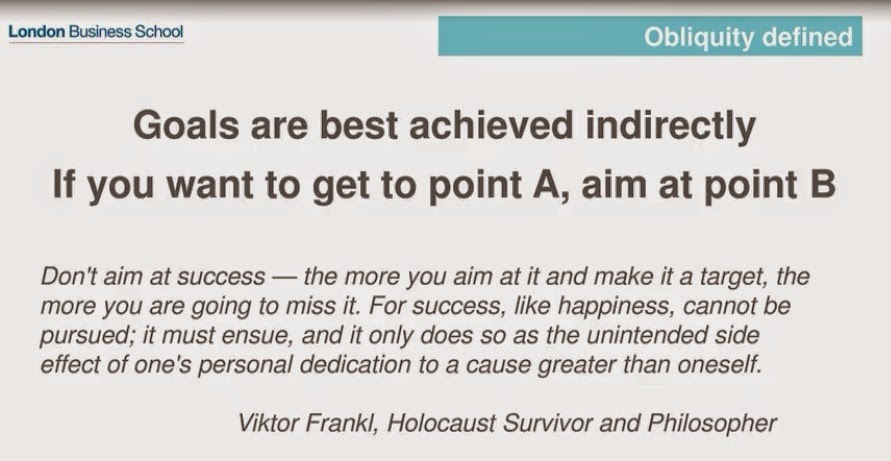 |
| Source: Managing the Company of the Future, Coursera + Julian Birkinshaw @ LBS |
Don't aim at success.
The more you aim at it and make it a target, the more you are going to miss it.
For success, like happiness, cannot be pursued; it must ensue,
and it only does so as the unintended side effect of one's personal dedication to a cause greater than oneself.
- Victor Frankl
Get UpNaira email updates
Friday, September 12, 2014
Tuesday, August 26, 2014
Obituary: 'Kunle Olaifa 1980-2014
Until his passing one week ago in a car accident, Mr. 'Kunle Olaifa was the Head of Human Resources, West Africa, for a large multinational company.
 A dedicated HR professional, Kunle built many careers. He of course built a stellar career for himself, with stints at Adecco HR Consulting, GE Energy, and Triangle Nigeria, as well as Career Solutions Africa and Samsung.
 He was an alumnus of the University of Ilorin and Nigerian Navy Secondary School, Abeokuta. He was also an AIESECer, an associate fellow of NLI - the Nigeria Leadership Initiative, and a thought-leader and frequent speaker on human resources at various fora including the Leadership Academies at DayStar Christian Center.
 But we remember him most for being a pillar of several communities, a leader, one who was very intelligent, visionary, concerned, engaged, funny, and kind. In plain language, he was a good friend, inspiring mentor, and a father figure to many. He was married with children.
 I will post below a few of the writings of Kunle that I can find on the internet, and hope you join his family, friends, and associates, as we all pay our respects to a fellow who lived an exemplary life.
Get email updates from UpNaira
Get email updates from UpNaira
The Unforgettable Boss
Unforgettable bosses possess qualities that may not show up on paper
but always show up where it matters most -- in the minds and even hearts
of the people they lead.
NOTE: THIS ENTIRE ARTICLE WAS EXTRACTED FROM A JEFF HADEN PIECE FOR LINKEDIN.ORG , also here on Inc.com
Here are some of the qualities of truly unforgettable bosses:
1. They believe the unbelievable.
2. They see opportunity in instability and uncertainty.
3. They wear their emotions on their sleeves.
Memorable bosses are highly professional and yet also openly human.
Professionalism is admirable. Professionalism -- with a healthy blend of humanity -- is inspiring.
4. They protect others from the bus.
Terrible bosses throw their employees under the bus.
Good bosses never throw their employees under the bus.
Memorable bosses see the bus coming and pull their employees out of the way often without the employee knowing until much, much later... if ever, because memorable bosses never try to take credit.
And if they can't, they take the hit. (And later speak privately to the employee in question.)
5. They’ve been there, done that... and still do that.
6. They lead by permission, not authority.
7. They embrace a larger purpose.
8. They take real, not fake risks.
In short, memorable bosses inspire others to achieve their dreams: by words, by actions, and most importantly, by example.
Get email updates from UpNaira
NOTE: THIS ENTIRE ARTICLE WAS EXTRACTED FROM A JEFF HADEN PIECE FOR LINKEDIN.ORG , also here on Inc.com
Here are some of the qualities of truly unforgettable bosses:
1. They believe the unbelievable.
2. They see opportunity in instability and uncertainty.
3. They wear their emotions on their sleeves.
Memorable bosses are highly professional and yet also openly human.
Professionalism is admirable. Professionalism -- with a healthy blend of humanity -- is inspiring.
4. They protect others from the bus.
Terrible bosses throw their employees under the bus.
Good bosses never throw their employees under the bus.
Memorable bosses see the bus coming and pull their employees out of the way often without the employee knowing until much, much later... if ever, because memorable bosses never try to take credit.
And if they can't, they take the hit. (And later speak privately to the employee in question.)
5. They’ve been there, done that... and still do that.
6. They lead by permission, not authority.
7. They embrace a larger purpose.
8. They take real, not fake risks.
In short, memorable bosses inspire others to achieve their dreams: by words, by actions, and most importantly, by example.
Get email updates from UpNaira
Tuesday, July 22, 2014
The World Can Afford to Shrink The Workweek
Interestingly, workers are not ready for the freedom that a shrinking workweek may entail. For many the fear is "if I'm not commuting to and from work daily or earning a better job title, then who am I?"- an existential crisis. The same type of fear that makes even wealthy people hate losing their job - rather than embrace the opportunities for a newer freer life, they're just upset because they want, more than anything zen you can think up, to keep in the game, so to speak. The job gives them meaning and order.
It is also true that many, particularly the poorest, need the jobs because they absolutely need the income. Employment creates a pathway, particularly for the poorest people, to scramble out of poverty into the realm of possibility.
Employment creates a pathway for the poorest NATIONS also, and this is why it must remain a pillar of economic policy in Nigeria and several other developing nations - massive employment gives the population something to do that is not destructive, it may sometimes give the people a skills ramp too so they can move to higher-value production, and - very importantly - it earns income in a granular way that goes direct to the people and fosters democracy rather than through a central source that then fosters inequality and crime and war in the extreme scenario.
Anyway, here are two comments on the need to shrink the workweek instead of moaning endlessly about unemployment:
Vivek Wadhwa, in We're Heading into a jobless future, no matter what the government does (The Washington Post):
"...Summers is right. Within two decades, we will have almost unlimited energy, food, and clean water; advances in medicine will allow us to live longer and healthier lives; robots will drive our cars, manufacture our goods, and do our chores. There won’t be much work for human beings. Self-driving cars will be commercially available by the end of this decade and will eventually displace human drivers—just as automobiles displaced the horse and buggy...
Summers is wrong, however, in his belief that governments can do as they did in the industrial age: create “enough work for all who need work for income, purchasing power and dignity.” They can barely keep up with the advances that are happening in technology, let alone develop economic policies for employment.
The only solution that I see is a shrinking work week. We may perhaps be working for 10 to 20 hours a week instead of the 40 for which we do today. And with the prices of necessities and of what we today consider luxury goods dropping exponentially, we may not need the entire population to be working. There is surely a possibility for social unrest because of this; but we could also create the utopian future we have long dreamed of, with a large part of humanity focused on creativity and enlightenment."
Larry Page, in this famous, and very highly recommended, chat that also features Google co-founder Sergey Brin and venture-capitalist Vinod Khosla.
"VinodKhosla The vast majority of employment shifted from farming to only needing about 2-percent of the U.S. workforce. That happened between 1900 and the year 2000. I see the beginnings of that happening again with the rapid acceleration the next 10, 15, 20 years.
LarryPage I totally believe we should be living in a time of abundance, like Peter Diamandis' book. If you really think about the things that you need to make yourself happy - housing, security, opportunities for your kids - anthropologists have been identifying these things. It's not that hard for us to provide those things. The amount of resources we need to do that, the amount of work that actually needs to go into that is pretty small. I'm guessing less than 1-percent at the moment. So the idea that everyone needs to work frantically to meet people's needs is just not true. I do think there's a problem that we don't recognize that. I think there's also a social problem that a lot of people aren't happy if they don't have anything to do. So we need to give people things to do. We need to feel like you're needed, wanted and have something productive to do. But I think the mix with that and the industries we actually need and so on are-- there's not a good correspondence. That's why we're busy destroying the environment and other things, maybe we don't need to be doing. So I'm pretty worried. Until we figure that out, we're not going to have a good outcome. One thing, I was talking to Richard Branson about this. They don't have enough jobs in the UK. He's been trying to get people to hire two part-time people instead of one full-time. So at least, the young people can have a half-time job rather than no job. And it's a slightly greater cost for employers. I was thinking, the extension of that is you have global unemployment or widespread unemployment. You just reduce work time. Everyone I've asked-- I've asked a lot of people about this. Maybe not you guys. But most people, if I ask them, 'Would you like an extra week of vacation?' They raise their hands, 100-percent of the people. 'Two weeks vacation, or a four-day work week?' Everyone will raise their hand. Most people like working, but they'd also like to have more time with their family or to pursue their own interests. So that would be one way to deal with the problem, is if you had a coordinated way to just reduce the workweek. And then, if you add slightly less employment, you can adjust and people will still have jobs.
SergeyBrin I will quibble a little bit. I don't think that in the near term, the need for labor is going away. It gets shifted from one place to another, but people always want more stuff or more entertainment or more creativity or more something."
Watch and/or read the complete fireside chat and transcript here.
It is also true that many, particularly the poorest, need the jobs because they absolutely need the income. Employment creates a pathway, particularly for the poorest people, to scramble out of poverty into the realm of possibility.
Employment creates a pathway for the poorest NATIONS also, and this is why it must remain a pillar of economic policy in Nigeria and several other developing nations - massive employment gives the population something to do that is not destructive, it may sometimes give the people a skills ramp too so they can move to higher-value production, and - very importantly - it earns income in a granular way that goes direct to the people and fosters democracy rather than through a central source that then fosters inequality and crime and war in the extreme scenario.
Anyway, here are two comments on the need to shrink the workweek instead of moaning endlessly about unemployment:
Vivek Wadhwa, in We're Heading into a jobless future, no matter what the government does (The Washington Post):
"...Summers is right. Within two decades, we will have almost unlimited energy, food, and clean water; advances in medicine will allow us to live longer and healthier lives; robots will drive our cars, manufacture our goods, and do our chores. There won’t be much work for human beings. Self-driving cars will be commercially available by the end of this decade and will eventually displace human drivers—just as automobiles displaced the horse and buggy...
Summers is wrong, however, in his belief that governments can do as they did in the industrial age: create “enough work for all who need work for income, purchasing power and dignity.” They can barely keep up with the advances that are happening in technology, let alone develop economic policies for employment.
The only solution that I see is a shrinking work week. We may perhaps be working for 10 to 20 hours a week instead of the 40 for which we do today. And with the prices of necessities and of what we today consider luxury goods dropping exponentially, we may not need the entire population to be working. There is surely a possibility for social unrest because of this; but we could also create the utopian future we have long dreamed of, with a large part of humanity focused on creativity and enlightenment."
Larry Page, in this famous, and very highly recommended, chat that also features Google co-founder Sergey Brin and venture-capitalist Vinod Khosla.
"VinodKhosla The vast majority of employment shifted from farming to only needing about 2-percent of the U.S. workforce. That happened between 1900 and the year 2000. I see the beginnings of that happening again with the rapid acceleration the next 10, 15, 20 years.
LarryPage I totally believe we should be living in a time of abundance, like Peter Diamandis' book. If you really think about the things that you need to make yourself happy - housing, security, opportunities for your kids - anthropologists have been identifying these things. It's not that hard for us to provide those things. The amount of resources we need to do that, the amount of work that actually needs to go into that is pretty small. I'm guessing less than 1-percent at the moment. So the idea that everyone needs to work frantically to meet people's needs is just not true. I do think there's a problem that we don't recognize that. I think there's also a social problem that a lot of people aren't happy if they don't have anything to do. So we need to give people things to do. We need to feel like you're needed, wanted and have something productive to do. But I think the mix with that and the industries we actually need and so on are-- there's not a good correspondence. That's why we're busy destroying the environment and other things, maybe we don't need to be doing. So I'm pretty worried. Until we figure that out, we're not going to have a good outcome. One thing, I was talking to Richard Branson about this. They don't have enough jobs in the UK. He's been trying to get people to hire two part-time people instead of one full-time. So at least, the young people can have a half-time job rather than no job. And it's a slightly greater cost for employers. I was thinking, the extension of that is you have global unemployment or widespread unemployment. You just reduce work time. Everyone I've asked-- I've asked a lot of people about this. Maybe not you guys. But most people, if I ask them, 'Would you like an extra week of vacation?' They raise their hands, 100-percent of the people. 'Two weeks vacation, or a four-day work week?' Everyone will raise their hand. Most people like working, but they'd also like to have more time with their family or to pursue their own interests. So that would be one way to deal with the problem, is if you had a coordinated way to just reduce the workweek. And then, if you add slightly less employment, you can adjust and people will still have jobs.
SergeyBrin I will quibble a little bit. I don't think that in the near term, the need for labor is going away. It gets shifted from one place to another, but people always want more stuff or more entertainment or more creativity or more something."
Watch and/or read the complete fireside chat and transcript here.
You may say I'm a dreamer, but I'm not the only one...
Saturday, August 24, 2013
Process thinking
I once worked in a place where things would often go wrong, and the question on the boss's lips would be "Who...?" as in "who did this?" "who was in charge of this..." so that the person would be in trouble and presumably the problem would go away.
Because the more important thing should be maybe "what" happened, and then "why" it happened, and then "why" that happened, and in that case you find yourself with the "root cause" which you can fix (along with the team, the who's that run the process) and then hopefully that issue would not crop up again.
Along with the inclination to abuse the "stupid employees" was this baffling habit of designing stupid processes, ones that put a great deal of strain on the boss and the people, and that relied more on hard work than on intelligence, and still produced a high error rate in the results.
I think the missing knowledge was of something called Process Thinking. Process thinking is important. It will make you calmer, and make your work many times easier and your results a lot better.
We think in small groups (I better pass my neighbour, God give me promotion) but ignore the self (does this make ME happy, can I sleep at night?) and ignore the whole too (is this the right thing to do, does it hurt somebody else?)
This mindset is understandable because we've come so recently from small worlds - small village, small ethnicity, small clan - but in the current world we all see that it doesn't produce very good outcomes. Individuals are frustrated and the country is poor. Working harder may not solve the problem. Defeating your neighbour, "feeling rich", getting promoted, "achieving success" may not be the answer.
A decade ago, I read that engineering was "the new liberal arts" degree. Along with whatever specific facts and knowledge it might give a student, it would develop his/her critical thinking, systems understanding, process thinking, and design ability. Then also it should broaden knowledge of the world and importantly of
self. It is a good training for an uncertain job title in an
interesting life.
Links for more learning
Lazy engineers: Unusual habits of good engineers
Process Thinking: It can make you happier at work and at home
Policy analysis: The Nigerian subsidy example, The technocracy example
Engineering processes
As an engineer, I found this to be the most puzzling thing. Why waste your time on such an irrelevant question as "who"?Because the more important thing should be maybe "what" happened, and then "why" it happened, and then "why" that happened, and in that case you find yourself with the "root cause" which you can fix (along with the team, the who's that run the process) and then hopefully that issue would not crop up again.
 |
| Good engineers are lazy |
I think the missing knowledge was of something called Process Thinking. Process thinking is important. It will make you calmer, and make your work many times easier and your results a lot better.
Individual and society
So too in my country in Africa, we think relationships are key to everything. In the name of basic relationships (what does my wife or my father think of me is the familiar question) we have institutionalized actions that harm self and harm the larger population too.We think in small groups (I better pass my neighbour, God give me promotion) but ignore the self (does this make ME happy, can I sleep at night?) and ignore the whole too (is this the right thing to do, does it hurt somebody else?)
This mindset is understandable because we've come so recently from small worlds - small village, small ethnicity, small clan - but in the current world we all see that it doesn't produce very good outcomes. Individuals are frustrated and the country is poor. Working harder may not solve the problem. Defeating your neighbour, "feeling rich", getting promoted, "achieving success" may not be the answer.
Engineering systems
Even on the political front, have some not tried to solve our misidentified "leadership problem" by replacing people? But we come to the realization that no, we must re-engineer systems instead. We must fix a risk-reward system at the individual, group, and institutional level. This is to say, we might think of a country or an economy as an abstract thing, or as an organism, or as a machine, in order to repair it.
School for intelligence
This is why I respect a good engineering education. It's one of those things that (hopefully) prepares you to understand systems (like the human body, the global economy, or the market for films) and processes (like the workflow at a branch office, the election of a president, the Arab spring). |
| a sketch of a helicopter by Leonardo da Vinci 500 years ago |
 |
| Cartoon showing laziness as the mama of invention |
Lazy engineers: Unusual habits of good engineers
Process Thinking: It can make you happier at work and at home
Policy analysis: The Nigerian subsidy example, The technocracy example
Wednesday, November 30, 2011
What an asshole!
I can't stand assholes. Steve Jobs was said to be a monumental asshole. The times I worked with assholes, basically I felt they created more trouble than whatever positives they had. Being an asshole is really not worth it. Everybody hopes you die.
Tom McNichol writes for TheAtlantic,

You should totally read the full article titled Be a Jerk: The Worst Business Lesson from the Steve Jobs Biography
Tom McNichol writes for TheAtlantic,
So many people advanced Steve Jobs as evidence that asshole CEOs build better companies that Sutton somewhat reluctantly included a chapter in his book on "The Virtues of Assholes," with Steve Jobs as Exhibit A. There is some evidence that "status displays" by aggressive bosses can motivate workers and give slackers a kick in the pants. And effective jerk bosses usually aren't assholes all the time, they're able to turn on the charm when the situation demands it, something Steve Jobs, by most accounts, was very good at doing. And it helps for companies to have skilled subordinate executives that are good at cleaning up after the Asshole-in-Chief, much like the sad-faced men carrying shovels who walk behind circus elephants.
But Sutton's book makes clear that for the most part, assholes are bad for the bottom line, to say nothing of the human toll they exact. There are plenty of very successful companies that aren't led by assholes - Google, Virgin Atlantic, Procter & Gamble and Southwest Airlines among them. Likewise, there are legions of assholes who lead companies that aren't successful, in part due to their own bad behavior.
You should totally read the full article titled Be a Jerk: The Worst Business Lesson from the Steve Jobs Biography
Thursday, September 02, 2010
The Good Bandwagon
It's better to hustle and take care of my own business.
It's best if I just make as much money as possible to defend against the horrors of the society. Remember that money can buy an SUV (to oppress potholes), a generator (to give the middle finger to NEPA), a ticket (to win a seriously high-paying job in future elections), a good address (to impress ladies) etc etc.
But before you join the band of hustlers, read this:
I was at a great seminar this week for future parliamentary staff, where I got some good answers to the question that has been on my mind for a while now:
WHy WOrk for tHe CoMmoN GOOD?
I ask this because some wonderful, talented, frankly great people are dropping out of the good wagon. They're looking around and saying, "Oh boy, I'm on my own o. I better just get money." In Lagos, many people already said this long time ago. They have their very good reasons for concluding that individual hustle is the answer, but they may be wrong, and in fact they may be making life worse for themselves by their choices.
Dr. A. Momoh in his answer to my question suggested a utilitarian argument for why common good is worth working for. Here is a scenario explaining the utility argument:
(A) I put in 10 units of effort and get 10 units of good... for myself, versus (B) I put in same effort and get 1 unit of good for each of 200 people, myself included.
Hey, then you see I just created 20 times more good. That's a higher utility/good. For high-minded people, this is a sufficient argument, since more good is created.
But not everybody is so high-minded. For normal selfish people, the question is "how many my share?" The scenario below shows that when we work for the common good, my own share also increases.
Imagine a society of 200 people all putting in 10 units of effort (but we will say later if they are working like A or like B), read on to see the amount of good in their lives:
(A) All selfish people putting in 10 units of effort each, will produce 2000 units of good (the citizens enjoy 10 units each.)
(B) All community-serving people putting in 10 units of effort each, will produce 40000 units of good (the citizens enjoy 200 units each. Wow. Now everybody wants to become a citizen of this community.)
Can you believe that it only takes 5% people being selfless to DOUBLE the good we each get.
If 11 people are community-serving, with 189 selfish, but remember all 200 make the same 10 units of effort, they will produce a total of 4090 units of good (the citizens enjoy more than 20 units each.)
From another speaker A. Sanusi's segment I gained an understanding of what Hobbes' Common-Wealth means. There is individual wealth, there is also common wealth. Join the bandwagon and invest.
It's best if I just make as much money as possible to defend against the horrors of the society. Remember that money can buy an SUV (to oppress potholes), a generator (to give the middle finger to NEPA), a ticket (to win a seriously high-paying job in future elections), a good address (to impress ladies) etc etc.
But before you join the band of hustlers, read this:
I was at a great seminar this week for future parliamentary staff, where I got some good answers to the question that has been on my mind for a while now:
WHy WOrk for tHe CoMmoN GOOD?
I ask this because some wonderful, talented, frankly great people are dropping out of the good wagon. They're looking around and saying, "Oh boy, I'm on my own o. I better just get money." In Lagos, many people already said this long time ago. They have their very good reasons for concluding that individual hustle is the answer, but they may be wrong, and in fact they may be making life worse for themselves by their choices.
Dr. A. Momoh in his answer to my question suggested a utilitarian argument for why common good is worth working for. Here is a scenario explaining the utility argument:
(A) I put in 10 units of effort and get 10 units of good... for myself, versus (B) I put in same effort and get 1 unit of good for each of 200 people, myself included.
Hey, then you see I just created 20 times more good. That's a higher utility/good. For high-minded people, this is a sufficient argument, since more good is created.
But not everybody is so high-minded. For normal selfish people, the question is "how many my share?" The scenario below shows that when we work for the common good, my own share also increases.
Imagine a society of 200 people all putting in 10 units of effort (but we will say later if they are working like A or like B), read on to see the amount of good in their lives:
(A) All selfish people putting in 10 units of effort each, will produce 2000 units of good (the citizens enjoy 10 units each.)
(B) All community-serving people putting in 10 units of effort each, will produce 40000 units of good (the citizens enjoy 200 units each. Wow. Now everybody wants to become a citizen of this community.)
Can you believe that it only takes 5% people being selfless to DOUBLE the good we each get.
If 11 people are community-serving, with 189 selfish, but remember all 200 make the same 10 units of effort, they will produce a total of 4090 units of good (the citizens enjoy more than 20 units each.)
From another speaker A. Sanusi's segment I gained an understanding of what Hobbes' Common-Wealth means. There is individual wealth, there is also common wealth. Join the bandwagon and invest.
Sunday, April 12, 2009
Work to Love
Two articles in today's New York Times address an issue I've been thinking about, we all have, for some time. Meaningful work; work that fits into life as you dream it, not work as a wage slave. you know what I mean. Check them out:
From "With Finance Disgraced, Which Career Will Be King?" Read More...
Well, there's always Nigeria etc. In Africa there's raw talent. There's high population. There are problems. There is a great need for competence in several fields. There is low-hanging fruit, so you can with little effort make a huge impact. There's often not the huge pay that you can expect in the West, although that can be arranged sometimes. It's worth a try.
P.S. Ask me about my own time in Nigeria (July 2008-July 2009) sometime.
P.P.S. Maybe we can arrange a chat between Africans returned to Africa and those thinking of returning...Shall we?
From an opinion piece in the New York Times. Read More...In the bubble decade, making money as an end in itself boomed as a calling among students at elite universities like Harvard, siphoning off gifted undergraduates who might otherwise have been scientists, teachers, doctors, entrepreneurs, artists or inventors. The Harvard Crimson reported that in the class of 2007, 58 percent of the men and 43 percent of the women entering the work force took jobs in the finance and consulting industries. The figures were similar everywhere, from Duke to the University of Pennsylvania. Dan Rather, on his HDNet television program in December, reported that at Penn this was even true of “over half the students who graduated with engineering degrees — not a field commonly associated with Wall Street.”
Clearly the last person to serve as an inspiring role model for alternative values would have been Summers. But in her first baccalaureate address last June, his successor as Harvard president, Drew Gilpin Faust, stepped into that moral vacuum, zeroing in on the huge number of students heading into finance, consulting and investment banking. “Find work you love,” she implored the class of 2008. The “most remunerative” job choice “may not be the most meaningful and the most satisfying.”
This same note was hit a month earlier by the commencement speaker at Wesleyan University, Barack Obama. “The big house and the nice suits and all the other things that our money culture says you should buy,” he said, amount to “a poverty of ambition.” He wasn’t speaking idly. As America knows, Obama turned down the lucrative career path guaranteed to the first African-American president of The Harvard Law Review to pursue the missions of service and teaching instead. The potential rewards for our country, now that that early choice has led him into the White House, are enormous.
But it’s hardly a given that the entrenched money culture has evaporated along with the paper profits it generated. One skeptic is Howard Gardner, the Harvard education professor who has created seminars at several elite colleges to counsel students in the notion of pursuing meaningful, ethical and effective work — “Good Work,” as he has titled it. He believes that many students may still be operating on the assumption that the world of finance will just pick up where it left off in a few years. “But we’re not going to be back there,” Gardner told me last week, “and we shouldn’t be back there.”
He notes that while the New Deal was built from ideas developed in the Progressive Era and that the Reagan counterrevolution was the culmination of the conservative movement of the 1950s and ’60s, there is as yet “no counternarrative to replace ‘money is king.’ ” The post-crash influx of graduates into Teach for America, while laudable, may be transitory unless there’s the political vision and leadership to make altruistic values stick after our crisis has passed. “It’s completely up in the air what’s going to happen,” Gardner said.
“In choosing careers, young people look for signals from society, and Wall Street will no longer pull the talent that it did for so many years,” said Richard Freeman, director of the labor studies program at the National Bureau of Economic Research. “We have a great experiment before us.”
What will the new map of talent flow look like? It’s early, but based on graduate school applications this spring, enrollment in undergraduate courses, preliminary job-placement results at schools, and the anecdotal accounts of students and professors, a new pattern of occupational choice seems to be emerging. Public service, government, the sciences and even teaching look to be winners, while fewer shiny, young minds are embarking on careers in finance and business consulting.
For the highest-paid business fields, the outlook is for a tempering correction instead of an all-out exodus. At Harvard, for example, about 40 percent of undergraduates in recent years went into the most lucrative corporate arenas like finance and consulting, based on surveys at the school year’s end. “That certainly won’t be the case this year,” observed Lawrence Katz, a professor and labor economist who has studied undergraduate career choices at Harvard going back to the 1960s. “We’re seeing students who would have been part of the Ivy League pipeline to Wall Street in the past considering very different career paths.”
Kedamai Fisseha, a 21-year-old senior, is one of them. An economics major, Mr. Fisseha says he always assumed he would go into finance, and his summer internship last year was at the investment bank Morgan Stanley. Yet after Wall Street’s meltdown, job prospects there have withered. Instead, he is interviewing with Teach for America, a nonprofit group that recruits college graduates to teach in hard-to-staff schools for two-year stints. (After that, only one-third stay in the classrooms, though two-thirds remain in education.)
Mr. Fisseha regards the turn of events as an opportunity to broaden his horizons. “It’s been liberating, and lucky for me,” he said. “But your situation does dictate your preferences.”
Graduate schools of government and public policy are seeing a surge of applications. In a survey of its members released last week, the National Association of Schools of Public Affairs and Administration found that 82 percent reported an increase in applications this year, and many saw the largest percentage jumps in several years, or ever. The most-cited reason was the expectation by students that government will be hiring.
Still, the appeal of public sector careers extends beyond job openings, say school officials. The laissez-faire presumption that government is not the solution but the problem, dating back to the Reagan era, has been cast aside, they say.
The government’s need to step in with financial bailouts and recovery programs to steady the economy is seen as the immediate proof, they say, but not the only one. The environment, energy and health care also pose huge, complex challenges. “Young people today understand that government has a powerful role to play in solving these problems,” said Sandra Archibald, dean of the Evans School of Public Affairs at the University of Washington, where applications this year are up 26 percent.
Government school officials also point to an Obama effect: his election as an endorsement of government activism.
From "With Finance Disgraced, Which Career Will Be King?" Read More...
Well, there's always Nigeria etc. In Africa there's raw talent. There's high population. There are problems. There is a great need for competence in several fields. There is low-hanging fruit, so you can with little effort make a huge impact. There's often not the huge pay that you can expect in the West, although that can be arranged sometimes. It's worth a try.
P.S. Ask me about my own time in Nigeria (July 2008-July 2009) sometime.
P.P.S. Maybe we can arrange a chat between Africans returned to Africa and those thinking of returning...Shall we?
Subscribe to:
Posts (Atom)

